
Stories Build Trust Like Nothing Else
The Science of Storytelling: Part Seven - Stories build trust. Trust is everything.

The Science of Storytelling: Part Seven
Personal Stories Build Trust Faster
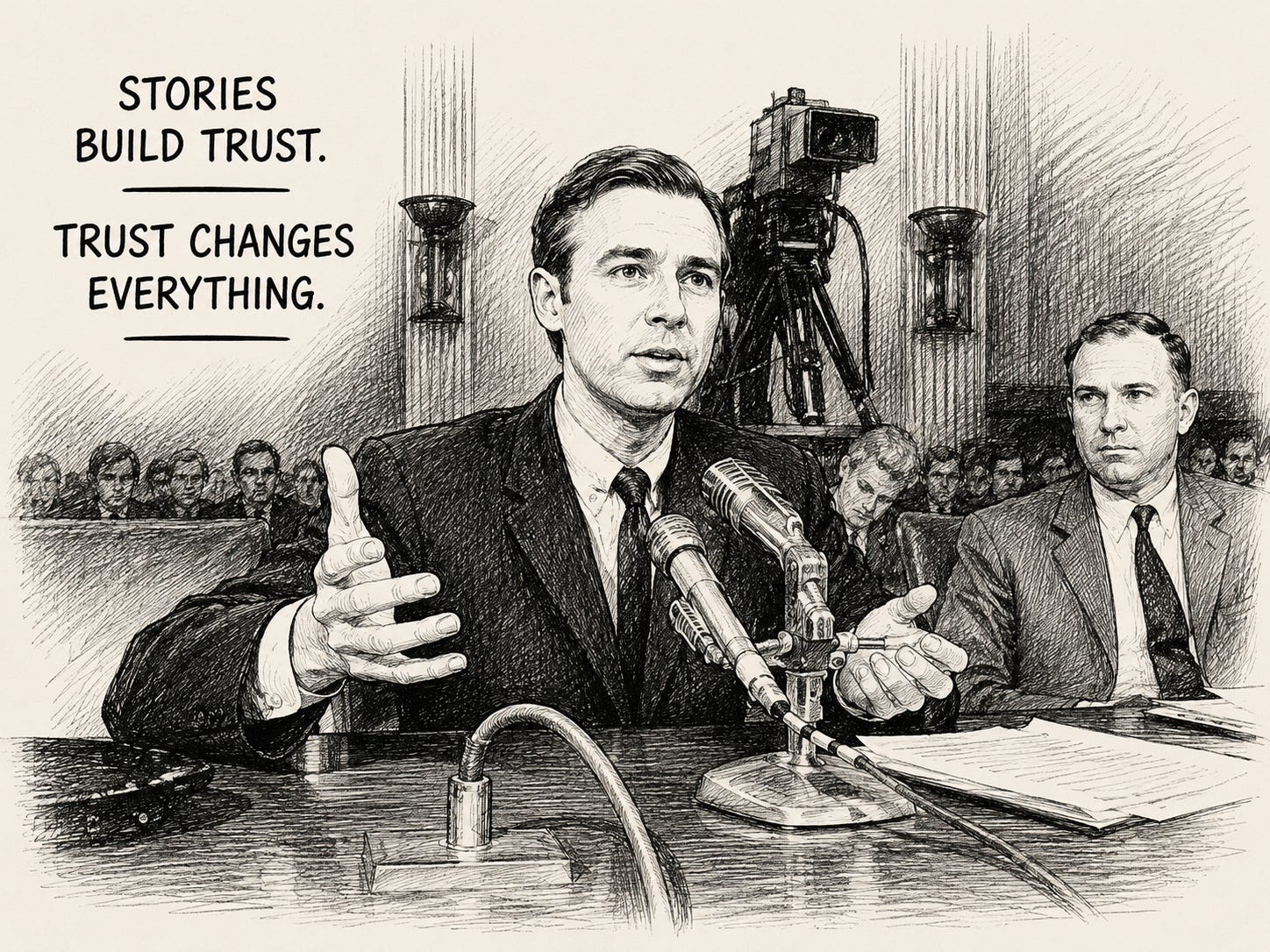
The room was not built for someone like him.
It was a Senate hearing room in Washington, D.C., 1969. Fluorescent lights. Dark suits. Papers stacked neatly in front of men who had already made up their minds about what mattered and what didn’t. The issue on the table was funding—specifically, whether the federal government should continue supporting public broadcasting. The number being discussed was $20 million. Not small, but in the context of Washington, not massive either.
Still, it was on the chopping block.
To many in the room, this wasn’t a philosophical debate. It was a budget decision. A line item. Something to cut.
And then he walked in.
Soft-spoken. Unassuming. No performance, no charisma in the traditional sense. He did not look like someone who came to win an argument. Across from him sat a senator known for being direct, skeptical, and not particularly patient with anything that felt unnecessary.
The dynamic was clear.
This was not going to go well for him.
He was given a few minutes to speak. No slides. No data dump. No attempt to overwhelm the room with statistics.
Instead, he told a story.
He talked about children—about what it feels like to be small in a world that often doesn’t make sense. About fear, anger, and confusion. About how those emotions, when ignored, don’t disappear—they grow. And he said that the work they were doing on television was about helping children learn to understand their feelings. To name them. To know that those feelings were mentionable—and therefore manageable.
He even quoted one of his songs: “What do you do with the mad that you feel?”
It was quiet. Almost disarmingly so.
No grand claims. No rhetorical flourishes. Just clarity. Just care.
Because the dominant story at the time was clear: Television was entertainment. Fast. Loud. Distracting. Something to keep kids occupied. He was telling an alternative story about what television could be. Television as formation. Television as relationship. Television as a place where a child might feel seen.
As he spoke, something in the room began to shift. The senator leaned forward. His tone softened. His posture changed. This was no longer just a budget hearing.
When he finished, the senator paused for a moment, then responded simply: “I think it’s wonderful. I think it’s wonderful. Looks like you just earned the $20 million.”
In six minutes, a story not only funded educational television.
It changed the way a powerful person understood everything.
That man was Fred Rogers.
And here’s what I want you to notice: He didn’t come in with credentials. He didn’t cite research or statistics. He didn’t try to impress anyone with his expertise or his track record.
He came in and let people see what he cared about.
And in doing that, he earned trust so completely that a skeptical senator became an advocate.
This is what personal stories do. They don’t just inform. They transform how people see you—and what they’re willing to believe about you.
Here’s the Science
Neuroscientists have found that personal stories activate the medial prefrontal cortex—the part of the brain associated with empathy, social connection, and decision-making.
When someone shares a real story (especially one that reveals struggle, vulnerability, or resilience), it triggers a kind of mirror response in our brains.
We relate before we rationalize.
We feel before we evaluate.
That feeling—”this person gets it”—is the foundation of trust.
It’s not just emotional. It’s neurological.
Why Trust Is Everything
My friend David Horsager, one of the top trust researchers in the world, puts it this way: “A lack of trust is your biggest expense.”
And he’s right.
In leadership, if people don’t trust you, they won’t follow. In sales, if they don’t trust you, they won’t buy. In relationships, if they don’t trust you, they won’t open up.
Trust isn’t just a “soft skill.”
Trust is the currency of every meaningful interaction.
And story is the fastest way to earn it.
Not spin. Not manipulation. Just an honestly told story.
Facts inform. Credentials impress.
But stories build trust.
If you want people to trust you—at work, in friendship, or on stage—don’t start with your expertise. Start with your experience. Especially the parts that made you human.
You can trust me on this one.
Up next in this series? Part Eight: Stories Make Ideas Stick
All paid subscribers now have access to my Called for Adventure Workbook to help you find your life calling in 12 days! Simply download the PDF below.
If you aren’t yet a paid subscriber, you can unlock the workbook by adjusting your subscription today: