
The Invisible Rules Running Your Life
Part Two of The Stories We Live Inside series - The Stories You Inherited

The Stories You Inherited
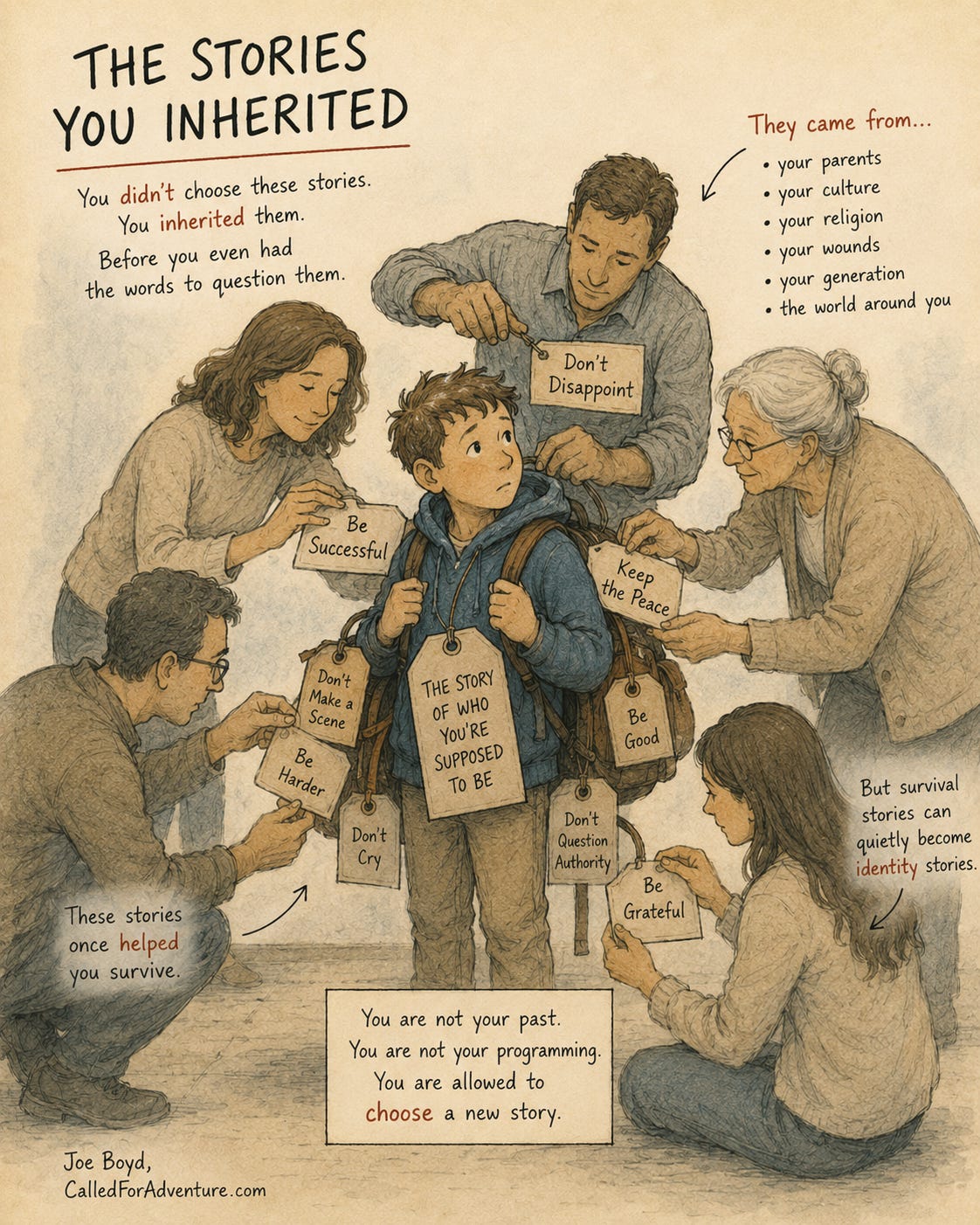
At some point, without realizing it, you inherited a set of rules for how to survive life.
Maybe they sounded like this:
Don’t disappoint people.
Work harder than everyone else.
Stay useful.
Keep the peace.
Don’t cry.
Don’t make a scene.
Be grateful.
Be good.
Be successful.
Don’t fail.
Don’t question authority.
Don’t be “too much.”
The strange thing is that most of us never consciously chose these rules.
We absorbed them.
From our parents.
Our religion.
Our schools.
Our culture.
Our generation.
Our trauma.
Our environment.
And after enough repetition, those rules stopped feeling a list of guidelines and became all encompassing narratives. They became our constant reality.
That’s why so many people wake up halfway through life exhausted, anxious, burned out, disconnected, or quietly unhappy without fully understanding why.
Many of us are still living inside a story we inherited before we were old enough to realize it. And we’ve been conditioned to believe that it’s wrong or dangerous to ever question it.
The Water You Were Born Into
Every one of us was born into a particular emotional ecosystem.
Some of us grew up in homes where achievement was everything. Some grew up in homes where emotions were dangerous. Some learned conflict meant abandonment. Some learned rest meant laziness. Some learned being “good” mattered more than being honest.
Some of us inherited religious stories.
Some inherited political stories.
Some inherited scarcity stories.
Some inherited fear stories.
And most of those stories were not taught directly.
Children learn by observation long before they learn by analysis.
You notice what gets rewarded.
You notice what gets punished.
You notice which emotions are welcome.
You notice what makes adults uncomfortable.
You notice what earns approval, affection, attention, safety, or belonging.
And slowly, without realizing it, you begin adapting yourself to the environment around you.
Of course you do.
Belonging is survival for all of us.
You don’t ask:
“Is this worldview healthy?”
You ask:
“How do I stay connected?”
“How do I stay safe?”
“How do I stay loved?”
Invisible Scripts
Most inherited stories are invisible precisely because they feel normal.
Nobody sat you down at age seven and formally announced:
“Your value depends entirely on productivity.”
But maybe you learned that anyway.
Maybe praise only came when you achieved.
Maybe mistakes brought shame.
Maybe vulnerability got mocked.
Maybe conflict felt emotionally unsafe.
Maybe the adults around you were constantly anxious, angry, avoidant, controlling, or overwhelmed.
And eventually the script writes itself:
I must perform to matter.
I must stay useful to stay loved.
I must stay in control.
I must never disappoint anyone.
I must avoid conflict at all costs.
I must stay small.
I must stay exceptional.
I must stay invisible.
The most powerful stories are always the ones nobody wants to say out loud.
Survival Stories
Here’s where I want us to be careful.
Most all of these stories were not irrational. They were adaptive.
A child growing up in chaos may become hyper-vigilant because vigilance helped them survive.
A child growing up around emotional instability may become a people pleaser because keeping others happy created safety.
A child raised in a rigid religious environment may become deeply compliant because questioning authority threatened belonging itself.
These stories often begin as protection.
The problem is that survival stories can quietly become identity stories.
And eventually the thing that once protected you starts limiting you.
Similarly, most of these stories are not bad. Especially when they coexist with other balancing and truthful narratives. Being faithful is not bad. Neither is being successful, compliant, or careful.
The power of these inherited stories isn’t that they are bad for you. It’s that they are good for you—until you overidentify with them and they begin to become the dominant steering force in your adult life.
The Moment the Story Cracks
Usually the inherited story works… until it doesn’t.
You achieve everything you were told to pursue and still feel empty.
You spend your entire life making everyone else comfortable and realize you disappeared somewhere along the way.
You hit burnout.
You question your faith.
You get divorced.
You have a breakdown.
You wake up one morning and realize:
“I don’t even know who I am anymore.”
That moment can feel terrifying.
But it can also become the beginning of freedom.
Because you cannot rewrite a story you cannot see.
Seeing the Water
Awareness is not betrayal.
Questioning an inherited story does not mean your entire past was fake. It simply means you are becoming conscious.
You are beginning to see the water you’ve been swimming in your whole life.
And once you can see the story…
…you finally have the ability to decide whether it is still one worth living inside.
Because, your life is a story.
And your life has one, and only one, author.
And it’s you.
Part of The Stories We Live Inside series:
The Story Running Your Life Right Now
The Stories You Inherited
Coming Next: The Story That Keeps You Small
Please Support My Work
If my work here is valuable to you, please support me in one of three ways:
Become a paid subscriber.
Give a gift on Venmo.
Preorder my new book, Story is the Strategy, via the links below:
Founding Story Partner — $300 ( All the above plus a private 60-minute 1:1 Story Strategy Zoom session.)
Thank you all for your support! I deeply appreciate you.
Being the oldest child in a family with 4 children my younger siblings learned by watching me what not to do, and what to do to please my parents.
Great stuff. I see a lot of that in me.